
Very few railway stations undergone a transformation greater than Birmingham New Street.
For many years, New Street Station was noted for its low ceilings, post-war Birmingham’s brutalist concrete architecture and dark, dingy platforms. Entering the station today means arriving directly into the magnificent atrium (and competing shops and restaurants) of Grand Central and the gently undulating curves of the Grand Central’s nearby structures.
The transformation of New Street wasn’t about a simple renovation of a station. It is about adding yet another chapter to the history of a site that has been numerous times rebuilt to accommodate the expansion of the city and, of course, the railway.
The First New Street
The appetites for Birmingham’s rapid growth and industrialization were met by various rival companies’ railway services, each of which established its corresponding separate stations.
Due to this fragmentation, New Street was built to address the need for an integrated central station. From this standpoint, the Midland Railway and the London and North Western Railway built the new station in the center of the growing city in the 1850s.
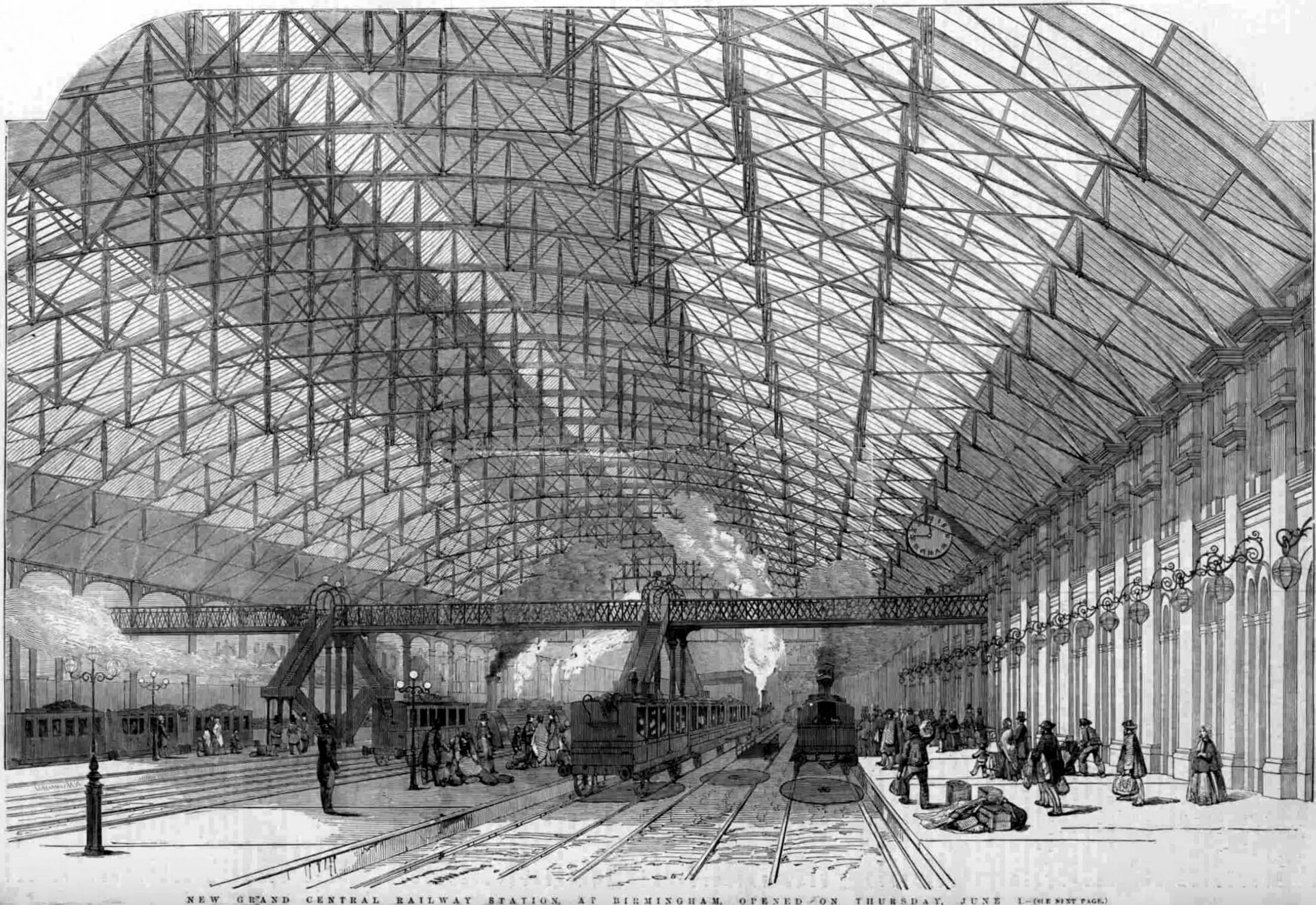
It was a substantial building for the time.
The station was eventually capped with enormous train sheds built over the platforms, and the Queen’s Hotel, built adjacent to the station, was one of the leading hotels in Birmingham.
Birmingham grew, and so did passenger numbers, as did the demands on the railway network. New Street was expanded during the nineteenth century to become one of the most important stations in the country.
Its location made that almost inevitable.
Routes going to and from London, the North West, Scotland, Wales, the South West and many others will all end up on Birmingham. New Street Station is not just a place were journeys will come to an end. Rather, it is a place where many trains will pass through on their way to their destination.
That continues to be the Stations purpose now.
A Station Beneath a City
During the mid to late 20th Century, Birmingham’s Victorian New Street station became outdated.
During this same timeframe, the modernization of Britain’s railway occurred. Comprehensive redevelopment of Birmingham and the West Coast Main Line’s electrification occurred.
The old station was not considered appropriate for the future of railways.
During the 1960s the decision was made to rebuild New Street Station.
Instead of maintaining the large Victorian train sheds, railways were built underneath a new commercial development.
The new station opened in stages during the second half of the decade while the Birmingham Shopping Centre was constructed over the new station.
From an engineering perspective, it was very efficient of railway space. For the passengers, however, they became very displeased with the results.
The Concrete New Street
The 1960s New Street was one of Britain’s more recognizable postwar railway stations.
Above ground was a large concrete complex, and below ground were closed platforms.
Natural light was nearly nonexistent.
New Street was unlike the other great Victorian termini for a variety of reasons, like the fact that it had low platform ceilings and a lot of concrete and an active railway.
First of all, there was no roof at New Street and no space to announce the arrival in a great city like St. Pancras.
Instead of walking around a great station, millions of people had to walk under a shopping center and a parking garage to take the actual trip to Birmingham.
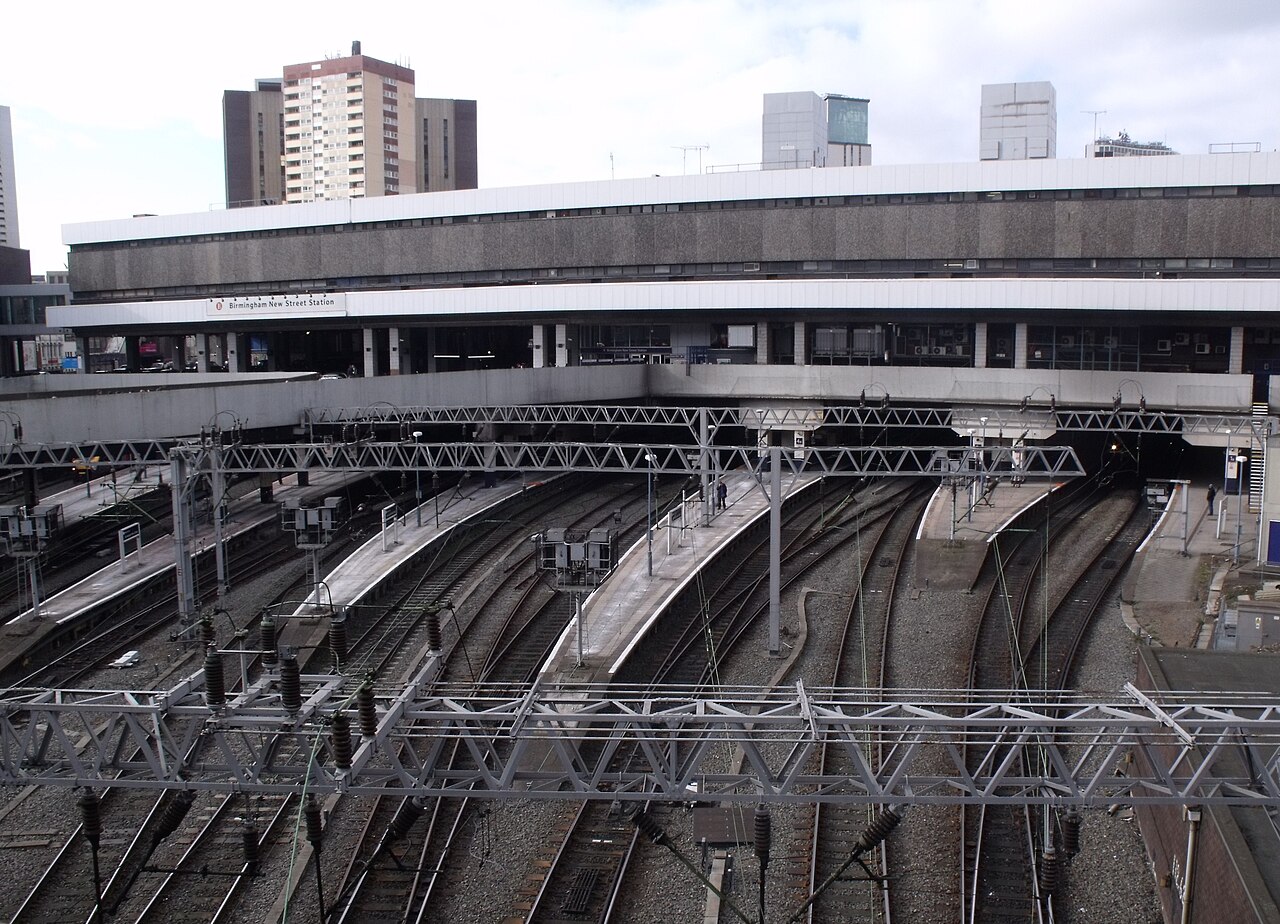
Still, New Street did an important job for the country.
The station remained an important location for the country’s rail services and even more so for the growing passenger numbers. Some of the InterCity services on the West Coast Main Line, the cross-country services between the South West, the South Coast, Northern England, and Scotland, and all of Regional and Local services traveled via New Street.
The passenger services, however, were not as impressive as the important services New Street offered.
New Street was bursting at the seams by the time the 1990s rolled around.
It had been built to accommodate a set number of passengers and after the privatization of the railways, it was clear that the passengers New Street accommodated well above that number.
It created a lot of congestion on the concourse as people traveled to get to the information screens that informed passengers of where to go to get to the restricted access points on the platforms.
Due to its location, replacing New Street was practically impossible and the solution wasn’t as promising as simply building a larger station.
The railway occupies a small city-center site, surrounded by buildings, roads, and other infrastructure. The railway has tunnels at the ends and provides vital service to the national network by using the existing tracks.
Total closure of the station and reconstruction of everything would take several years. This was never an option.
What was needed was much more complicated.
The New Street Gateway Project
The New Street Gateway Project was the answer.
The project would greatly improve passenger areas of the station while the railway continued to operate.
Work started in 2010.
This was major surgery on one of Britain’s busiest stations. The project would allow the station to continue to operate during the construction work.
The project would completely rebuild the concourse, change the entrances and circulation, and completely redesign the station’s appearance.
Above the redesigned concourse the project would provide a major new retail center called Grand Central.
The project was known for its innovative use of stainless steel along its exterior.
Rather than the heavy concrete of the original structure, the new station would be enclosed with thousands of steel panels that would create the many curved and reflective surfaces now common throughout Birmingham.
The contrast was dramatic.
Building New Streets While Trains Kept Running
Building the new New Street while maintaining the rail services was very challenging.
New Street could not be built out of service, as its importance to the rail network meant it had to remain open.
Throughout the construction, several hundred trains used the station daily.
Phase one of the project commenced in 2013 and included the first completed section of the concourse. This allowed the payload to move to the new space and closed the old concourse to enable construction on subsequent project phases.
For people who used the station regularly, this phase meant going through the construction process with and then without sections of the original station and new sections, and using temporary ways through the station and construct work that was covered with hoardings. Behind these hoardings the original New Street station was being dismantled and replaced.
In 2015, Birmingham New Street and Grand Central were fully opened.
People walking to the station for the first time in several years saw a newly transformed station that had a new large atrium.
The atrium provided a new unobstructed way to pass natural light to the passenger areas.
Having shopping and business services located at different levels and connected by escalators surrounded the central space and afforded a new view of Birmingham.
Grand Central built a new major retail area and brought John Lewis to the city center and replaced the unattractive concrete mass.
The station changed Birmingham’s image for the better with a building that stood proudly among others, instead of being apologetic about it.
But What About the Platforms?
The changes that unfolded above ground were significant.
Things, unfortunately, were a bit more complex at platform level.
Anyone expecting the platforms themselves to have adopted the style of a completely new railway station may be disappointed.
The underlying railway geography at New Street remained largely unchanged.
Platforms continue to occupy constrained space below the development. Trains still come through tunnels, and the station, unsurprisingly, remains under built up structures.
The redevelopment improved the platforms with new finishes, lighting, and signage, though the constraints of the site meant that it could not be completely removed.
That is why the character of New Street changes so dramatically in a matter of minutes.
From the Grand Central atrium, the experience of the station is large, bright, and modern.
The character quickly changes to an underground environment upon descending to platform level.
That contrast is, in many ways, an integral part of the redevelopment.
The project created a new way for passengers to interact with and experience New Street while still acknowledging that the complicated networks of railways underneath could not be easily rebuilt.
More Than a Railway Station
The transformation of Birmingham New Street also embodied a changing perception of major railway stations.
Increasingly, stations were treats in and of themselves, and became full destinations and not just connections.
London St Pancras demonstrated the integration of transport with a huge retail and hospitality space, and other major stations began to redevelop with the goal of providing passengers the opportunity to shop, eat, and meet before or after their journey, but before boarding.
Grand Central brought that to Birmingham.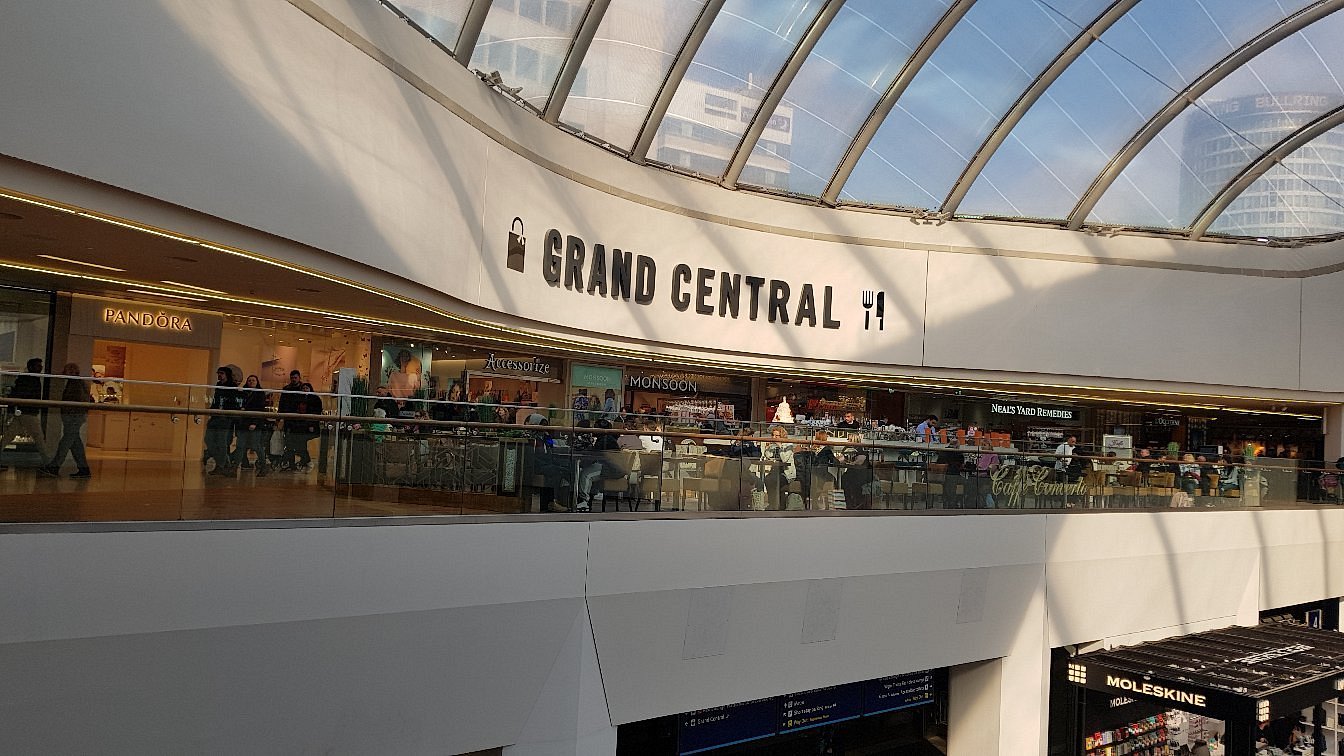
The shopping center and railway station became one’s and the same.
For Birmingham, this was a continuation of the efforts to centralize the city.
New Street is one of the main avenues travelers get their first look at Birmingham City. Because of that, the appearance and atmosphere of the station are more important than just the workings of rail.
The original building showed guests they had arrived at a shopping center in the 60’s.
The new building was made to show guests that they arrived at a city that invested in its future.
New Street’s Railway Importance Never Went Away
Even with drastic shifts in design, New Street’s importance maintained its consistency.
It is still one the important crossroads of the U.K. Passenger Railway.
Avanti West Coast services connect Birmingham with London and the North.
CrossCountry trains offer travel across the country and connect the South West and South Coast with the Midlands, northern England and Scotland.
West Midlands Railway offers regional and local travel, and Transport for Wales offer train travel to Wales.
It makes for a unique station environment.
Many of the travelers using New Street are not starting or ending their trips in Birmingham. They are making changes.
This makes the information clear, easy changes and providing the ability to navigate travelers between the different platforms critical.
The challenge of fitting so much activity on the railway in such a small area is still present, even with the changes made to New Street over the years.
A Building That Divides Opinion
There isn’t widespread appreciation for New Street.
The building’s mirrored exterior is bold, and most contemporary architecture does divide opinion.
Many consider the use of stainless steel to house a huge atrium an upgrade over the concrete station, while others consider the redevelopment lacking for improving the enclosed environment of the rail infrastructure.
There is an element of truth in both perspectives.
The project did not construct new rail beneath Birmingham, instead focusing on the creation of a new passenger and city center environment surrounding the railway.
Before and after completion of the project, photos of New Street show significant changes to the surrounding environment.
The rail lines and some platforms were maintained, though the environment above them was almost completely new.
From Concrete Giant to Grand Central
The history of New Street reflects the changes needed for a railway system in a growing city.
The original Victorian Station eventually could not keep pace with modern railway needs.
The 1960s replacement of the Victorian Station provided a solution for the modern railway needs of the time while introducing more issues. The station served and continues to serve an important role in the National Transport System, though the passenger service was poor.
Half a century later, Birmingham made new attempts.
There remain some rail constraints and challenges beneath New Street. The rail system remains active and busy. Outside the platforms there are significant changes.
Passengers used to walk through a low, concrete passageway beneath a shopping center to enter the platform. They now exit into a vast, bright atrium. The curves and reflections of Grand Central extend to the huge space, making it an attractive entry.
New Street exemplifies the changing attitudes towards the British railways and cities.
New Street has simply been a Victorian Train Shed, a post-war concrete giant, and now a 21st-century transport and shopping center.
For more feature articles click here. For the latest going on at RT click here.


