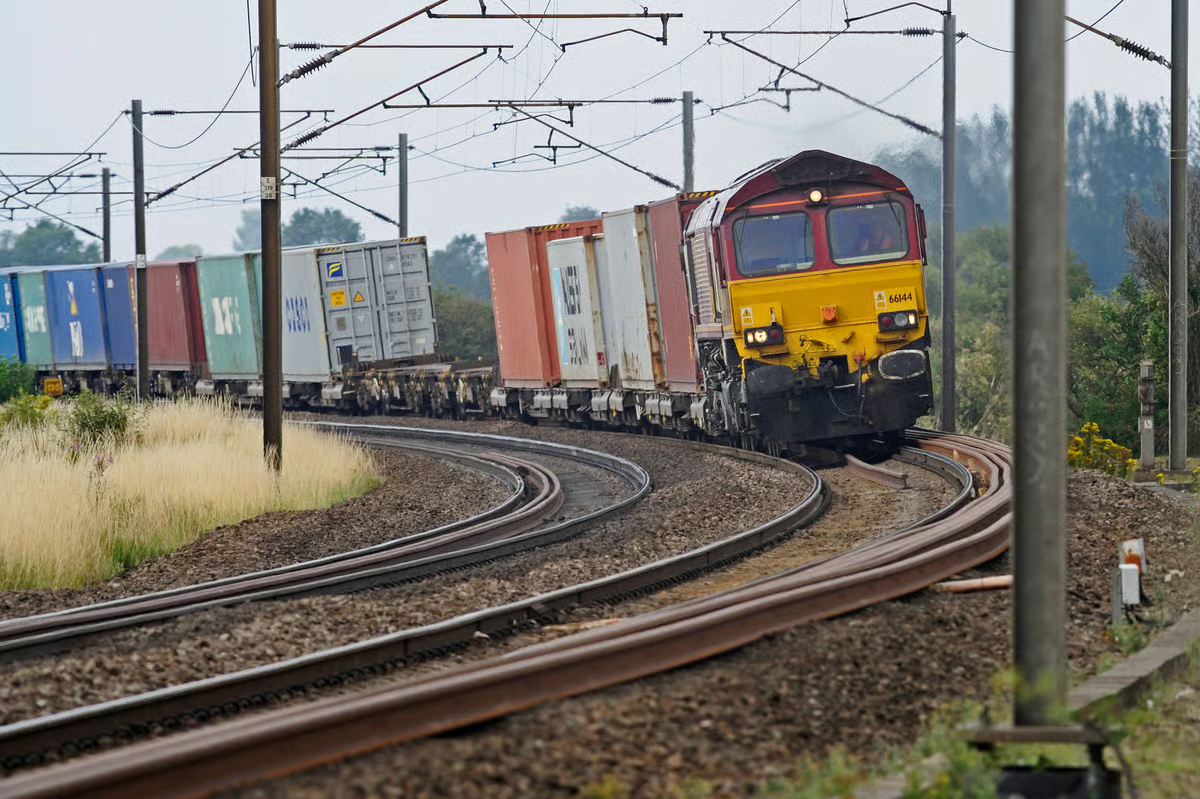
Every day, thousands of trains travel across Britain’s railway protected by a safety system most passengers will never see. Understanding how TPWS works helps explain one of the most important layers of protection built into the modern railway.
Each day in Britain, thousands of trains travel along routes with a safety system most passengers will never see. Known as the Train Protection and Warning System (TPWS), it helps protect against some of the most dangerous situations in train management. TPWS has been deployed Along with other safety measures after a series of major rail safety incidents in the UK in the 1990s. Unlike some of the more sophisticated train control systems, such as the European Train Control System, TPWS does not provide continual oversight to the movement of trains. equipment sited at various locations communicate with equipment fitted to the train. The system is designed to apply emergency braking if one of the safety-related parameters is breached.
Why Was TPWS Introduced?
To understand TPWS we first need to understand the problem that it was designed to solve.
The term SPAD (Signal Passed at Danger) is used to describe a train that has passed a signal displaying a stop command.
Not all SPAD incidents result in accidents. Some sections of railway are designed to have protected overlaps in order to reduce the risk of an error resulting in an accident. However, it is always possible for a train to pass a signal displaying a “Stop” command and then enter a section of railway used by another train or move to a conflicting route.
Several major rail incidents that occurred during the 1990s highlighted the potential catastrophic effects of SPAD incidents.
In 1997, a Great Western Trains InterCity 125 collided with a freight train after failing to stop at a signal in Southall. Seven people were killed.
In 1999, the Ladbroke Grove rail crash occurred when a First Great Western HST collided with a Thames Trains service after crossing signal SN109 at danger. Thirty-one people were killed in the crash.
Following both the Southall and Ladbroke Grove crashes, there was public and parliamentary pressure to improve the means of automatically stopping a train after it had passed a red signal, and so Great Britain introduced the Automatic Warning System (AWS), whereby audible and visual signal warnings are provided to the driver.
However, AWS has significant drawbacks.
AWS provides warning signals for all signals and other conditions. In such cases, a driver can proceed past the signal, without stopping. As a result, AWS, by itself, cannot guarantee that a train will stop after crossing a danger signal.
The limitations of AWS were further addressed with the introduction of TPWS.
TPWS Does Not Drive the Train
There have been several misunderstandings concerning the operation and functioning of TPWS.
TPWS will not drive a train.
Ultimately, the driver retains the responsibility to observe signals, control the speed of the train and brake as appropriate.
TPWS operates as a safety net.
In circumstances where certain conditions indicate that a train is traveling too fast or a protected signal has been passed at danger, the system will command an emergency brake application.
The basic system uses equipment fitted between the running rails, called TPWS loops.
Equipment, correspondingly, is fitted beneath the train to receive signals transmitted by the loops.
There are two ways in which TPWS provides protection due to the Train Stop System and the Overspeed Sensor System.
The Train Stop System
The Train Stop System (TSS) is arguably the most straightforward of the systems of TPWS.
A pair of transmitter loops are installed near a signal.
When a signal displays a proceed aspect, a train is free to pass.
If, however, a signal is at danger, the TPWS train-stop loops become active.
Should a TPWS equipped train pass over these active loops, the equipment detects that a signal has been passed at a protected aspect, and an emergency brake is automatically applied.
The purpose of this is not, of course, to bring the train to a standstill before the signal, as by that time it has already passed the signal.
Rather, an emergency brake application is designed to reduce the speed of the train and to prevent the train from colliding with another train.
The speed of a train cannot be reduced to zero instantaneously.
For this reason, another system of TPWS is used to establish whether a train is approaching a hazard at a speed that is unsafe.
The Overspeed Sensor System
The Overspeed Sensor System (OSS) employs two pairs of loops that are spaced at a specified distance apart.
Timing starts as a train completes the first set of loops.
The train crosses the second set of loops.
If a tight time span exists between the two sets of loops, TPWS tells the train that it is exceeding the allowed intervention speed and commands the train to apply an emergency brake.
However, if time is not a factor, the system knows that the train is below the intervention speed and takes no action.
The concept is fairly simple, but there is tremendous value in the safety function.
OSS can be installed on the approach of several signals where a train must slow down to a complete stop.
Protecting Signals Before They Are Passed
Combining OSS and TSS provides more protection than just stopping a train after it passes a red signal.
Imagine a train speeding up towards a signal at danger.
The driver would have slowed the train down when warned with the preceding signals.
However, if the train is speeding up too fast to reach a red signal, the overspeed device will activate before the train reaches the red signal.
Most importantly, the emergency braking would be activated sooner.
Should a train reach a danger signal, the Train Stop System offers a last chance to intervene.
The two systems are complementary.
TPWS makes no guarantee regarding the mixing paths of every train. Stopping before a collision is dependent upon speed, braking performance, and the distance to the collision.
However, it lessens the risks.
What Happens in the Cab?
In the cab, from the driver’s viewpoint, the TPWS system is mostly passive and intervenes only if required.
The cab control and indication system allows the driver to see system status.
In the case of overspeed or train-stop activation, an emergency brake is applied.
The driver cannot clear the demand.
A process requires the driver to ascertain the reason for the activation and place a call to the signaller.
With the activation of the system, something potentially serious has occurred, and the protection the system is designed to provide should not be compromised by an immediate reset.
For this reason, both the signaller and driver are given an opportunity to determine the system activation reason before the system is placed back in the control state.
Where is TPWS Installed?
TPWS equipment will not be found next to every signal on Britain’s railway network.
Equipment will be found in the more serious consequence areas where a train may not be able to stop to control its speed.
This may include many signals based at junctions and other sites of potential conflicts.
Equipment may be found at more serious temporary speed restrictions and on approaches to station buffer stops.
This installation will be used to prevent trains entering terminal stations platforms with excessive speed.
People on a station platform might have walked past the components of TPWS (train protection and warming system) without even noticing it. The equipment is small, rectangular control units between the rails that can be hidden amongst the collection of equipment along the side of the tracks.
Despite their appearance, as control units, they are an important part of modern rail safety.
TPWS Works with AWS
AWS and TPWS complement each other, although AWS and TPWS have distinct functions respectively.
AWS is a driver warning system.
Whereas TPWS can take things a step further and intervene.
To illustrate with an example, when a train is approaching a restrictive signal, AWS has the ability to alert the driver with a warning that cannot be ignored.
As a cautious and responsible driver, upon receiving this warning, the driver will take appropriate control of the train.
However, if the train is approaching a TPWS protected signal at an unsafe speed, TPWS will activate the train braking system.
Both systems rely on good signaling and safe driver practices.
Transportation safety safety systems as TPWS were developed with the rationale of having several layers of protection where a single failure would not ensue catastrophic failure.
What TPWS Cannot Do
TPWS, as important as it is, has its own limits.
Most importantly, it cannot continuously monitor speed control.
Once a train passes a TPWS equipped segment of track, TPWS ceases to calculate if the train speed is appropriate for the segment of track.
TPWS also cannot stop a train traveling at high speed.
This concern becomes especially relevant on lines with high operating speeds. A high speed train, at 100 or even 125 mph, would require a long braking distance which could be beyond the protection provided by an average TPWS installation.
TPWS+ is a newer arrangement. Additional overspeed sensors have been installed further away from the signal. As a train approaches at speed, an intervention can now be initiated earlier.
TPWS+ still does not offer full continuous train protection.
TPWS+ is a targeted intervention system.
Why Wasn’t ATP Installed Instead?
Prior to the introduction of TPWS, British Rail had undertaken more complex automatic train protection (ATP) trials.
ATP is able to continuously monitor train speed and movement authority, thereby offering more protection than TPWS.
Testing was done on the Great Western Main Line and on the Chiltern routes.
The installation of ATP on the national network would have been a major investment.
TPWS was a system that could be deployed very quickly, with much less expenditure, to deal with a large portion of the risk due to SPADs.
Time and speed of implementation was critical after the major accidents of the late 1990s.
TPWS could be rapidly deployed across a large portion of the network and to rolling stock, without needing a complete signalling redesign.
It therefore was not designed as a complete system of train protection.
It was a rapid intervention with significant safety benefits.
From TPWS to ETCS
The railway is now entering another generation of train protection.
The European Train Control System (ETCS) provides continuous protection and control and forms the basis of the UK’s digital railway.
Under ETCS, the driver receives information regarding movement and speed authorizations. The system is able to control the train independently based on the information gathered. This system operates at a much more complex level than TPWS.
That said, deploying ETCS is a long process.
Given that Great Britain has thousands of miles of track, numerous signals, and many different train types, converting the entire system to digital signaling will not be easy and not an overnight process.
TPWS provides a critical layer of protection during the implementation of ETCS.
A Safety System Passengers Rarely Notice
The most appreciation that can likely be shown to TPWS is that most passengers will not likely ever know that it exists.
It sits between the rails, out of sight and underneath trains, waiting for conditions to go wrong.
Most of the time TPWS is not required to act.
Drivers respond to signals and trains operate at appropriate speeds, meaning TPWS only has to sit to the side and watch.
However, its existence reduces the chance that a mistake will result in a catastrophe.
The accidents at Southall and Ladbroke Grove showed what can happen when a train disregards a signal, and there is no system intended to stop the train.
TPWS was introduced with the goal of reducing the risk that a signal was passed at danger.
While not perfect, it is not expected to be the final rail safety system, as more advanced systems such as ETCS and digital signaling will provide even better controls.
For more than two decades, the Train Protection and Warning System has acted as a safety measure against workplace mistakes resulting in significant disasters.
This system is a low-tech solution with a high-value function. It protects trains, drivers, and passengers with minimal awareness of the technology’s presence.
Want to learn more about how trains work check out this article here on brakes. Keep up to date with the latest at RT by clicking here